


Quick Answer: Yes, IPTV is legal when the provider has the licenses to distribute its content. Many services stream copyrighted content without permission, and using them can bring legal, privacy, and financial risks.
Rule of thumb: Thousands of premium channels and sports for a few dollars a month is a warning sign.
This guide covers how legal and illegal IPTV differ, what the law says in different countries, and five checks to run before you subscribe.
Given the legal complexities and copyright concerns surrounding unverified IPTV providers, streaming IPTV through a VPN is recommended. A VPN masks your real IP address and encrypts your connection, protecting your identity and personal data online.
Recommended VPN for IPTV - Surfshark
Using IPTV without a VPN can put you at Big Risk! Your ISP, government and even IPTV providers can monitor your activity, throttle your speed, or block access altogether.
Plus, without encryption, your data is exposed to hackers and third parties. Take back your privacy with Surfshark!
Features:
✅ SAVE 87% + GET 3 EXTRA MONTHS FREE! ($0.06/day)
✅ Kill Switch Feature to protect you if VPN drops
✅ Lightweight app ensuring smooth performance on All IPTV Boxes
✅ Unlimited simultaneous connections (install on all household devices)
✅ 30-day risk-free money-back guarantee
✅ Strict no-logs policy, Secure & Untraceable
Legal vs Illegal IPTV Services
| Legal IPTV | Illegal IPTV | |
|---|---|---|
| Content | Has broadcasting licenses and distribution rights. | Streams copyrighted content without permission. |
| Price | Free, ad-supported, or paid plans at normal market prices. | Thousands of premium channels at unusually low prices. |
| Company | Official website, company details, and support. | Hidden owners; sells through Telegram or WhatsApp. |
| Payments | Cards, PayPal, app store payments. | Often crypto, gift cards, or direct transfers. |
| Reliability | Stable streams, app updates, support. | Buffering, broken streams, sudden shutdowns. |
| Legal risk | Generally none. | Providers, and in some countries, users, face copyright penalties. |
Is IPTV Legal in Your Country?
Licensed IPTV is legal worldwide. Unauthorized streaming is treated differently from country to country, and authorities mainly target operators and resellers, but subscribers can face consequences too.
- USA, UK, Canada, Ireland, Australia: copyright infringement can lead to fines, civil lawsuits, or criminal penalties, depending on the violation.
- European Union: member states enforce copyright law against unauthorized streaming, but penalties and enforcement differ by country.
How to Tell If an IPTV Service Is Legal
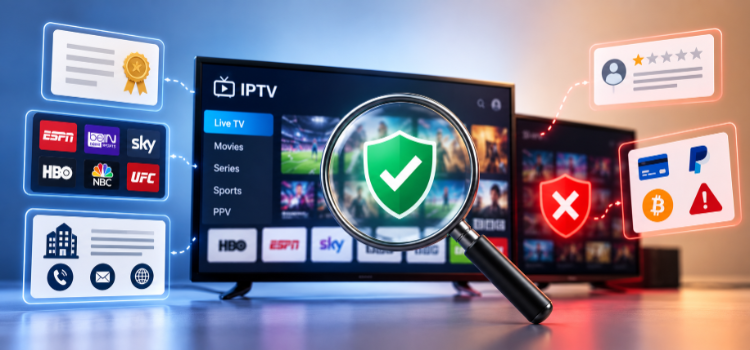
No single check is proof, but these five help you spot unlicensed services.
1. Check the licensing
Look for named broadcasting partners or other credible proof of licensing. If it’s unclear, ask the broadcaster or content owner.
2. Look at the channel package
Thousands of premium channels, international sports, and PPV events at a very low price are a red flag. Broadcasting rights are expensive.
3. Check company information
A legitimate provider has verifiable business details, responsive support, clear terms, and a privacy policy. A professional-looking site alone proves nothing.
4. Read independent reviews
Search forums and complaint sites. Watch for disappearing websites, frequent rebranding, refund problems, and repeated outages.
5. Review the payment methods
Prefer methods with buyer protection and dispute options, and don’t share more personal information than needed. Card or PayPal support doesn’t prove a service is licensed, and crypto doesn’t automatically mean it’s illegal.
How Do ISPs Crack Down on Illegal IPTV Networks?

Copyright holders and police look at unauthorized streams, servers, payment records, and reseller networks. Depending on local law, this can mean server shutdowns, blocked websites, seized profits, or prosecution of commercial operators.
Recent cases:
- International, February 2026: Eurojust reported an operation against illegal streaming services used by millions of viewers. Investigators traced network traffic and cryptocurrency transactions to find the people and infrastructure behind it.
- United Kingdom, August 2026: An IPTV operator was sentenced to six and a half years in prison after earning £980,812 from unauthorized streaming. Police seized 80 servers. According to City of London Police, he captured TV broadcasts, converted them into IPTV streams, and sold subscriptions worldwide.
What to Do If You Get an IPTV Copyright Warning
Some internet users receive copyright notices after their connection is linked to suspected unauthorized streaming. A notice doesn’t automatically mean you’re guilty, and the chance of being arrested is low, but don’t ignore a legitimate one.
- Verify the sender. Contact your ISP through its official website or phone number.
- Read the allegation. Check which activity, date, or content it names.
- Avoid payment links. Don’t share sensitive details through unverified messages.
- Stop questionable activity. Check whether the service is legitimate before using it again.
- Get legal advice if needed. Talk to a qualified lawyer if you receive formal legal papers or a payment demand.
Does a VPN Make IPTV Legal?
No. A VPN doesn’t make illegal IPTV legal. Any VPN like Surfshark will only encrypt your traffic, hide your IP address from streaming destinations, and limit what your ISP can see.
But it can’t authorize a provider to distribute copyrighted content, and it doesn’t protect you from malware or legal consequences.
FAQs
Can you go to jail for watching IPTV?
It depends on local law and what you did. Authorities mostly prosecute commercial operators, but subscribers shouldn’t assume they have no legal risk.
Are IPTV players and M3U playlists legal?
Yes. Players like TiviMate, IPTV Smarters Pro, and VLC are legal, and so are M3U playlists and Xtream Codes. Using them to access copyrighted content from unauthorized sources may break the law.
Are cheap IPTV subscriptions illegal?
Not necessarily. Legitimate services can be cheap or free. But a very low price for lots of premium channels and sports is worth checking for proper licensing.
Is reselling IPTV subscriptions legal?
Only if you’re authorized to distribute the content. Selling unauthorized access to copyrighted channels can lead to infringement claims and criminal penalties.
Are unverified IPTV services safe?
Not always. They can expose you to malware, payment fraud, privacy risks, and unreliable streams. Download apps from trusted sources, check app permissions, use strong passwords, and research the provider first.
Conclusion: Is IPTV Legal and Safe?
IPTV is legal when the provider has the licenses for its content, and licensed services are the safer way to watch live TV, movies, and sports. Illegal providers may look cheap, but they bring legal risk, privacy problems, payment fraud, and sudden shutdowns.
Before you subscribe, check the licensing, company details, payment options, and reviews. I also recommend a premium VPN like Surfshark for extra streaming privacy, though it cannot make unauthorized IPTV legal.

